SOUTHERN NEW MEXICO
NM Supreme Court pauses Project Jupiter air permit
Justices issue Sunday night order staying proceedings


Published
Modified
In a unanimous order issued Sunday night, the New Mexico Supreme Court granted a temporary stay that pauses proceedings on a crucial permit for the hyperscale data center under construction in Santa Teresa, known as Project Jupiter.
The five justices granted the stay as they consider a petition filed by Santa Fe-based New Energy Economy, a clean energy advocacy organization, arguing that the New Mexico Environment Department cannot proceed with a public hearing into the data center’s air quality permit application because it has not established the project’s fuel source.
In a brief order, the court granted a stay of the administrative proceedings until further order and stated that any replies ordered by the court would be filed no later than Sept. 2.
The order, filed at 8:21 p.m. Sunday, fell on the eve of the Environment Department’s deadline to produce the permit’s full administrative record and for challengers to submit their technical testimony.
The justice also issued a Sunday-night order in a separate case, granting a temporary stay on the Office of the State Engineer’s authorization of a new well supplying water for Project Jupiter’s construction.
New Energy Economy Executive Director Mariel Nanasi called the order “an extraordinary and necessary intervention� in a statement late Sunday night.
An Oracle spokesperson defended the Environment Department’s permitting process and said, “We are committed to protecting New Mexico’s resources, are abiding by every applicable regulatory process and public review period, and have complied with every required timeline along the way.�
Oracle also reiterated that the current permit application represents a less carbon-intensive design than its initial microgrid proposal. The company cited its pledges to enact a carbon-matching program and to work with agricultural tech company Arable on a water-efficiency initiative it says will conserve 21 million gallons of water per year.
“The effort to bypass the department’s established procedural deadlines is unwarranted, but we will continue to share facts about the project transparently and are confident the regulatory process will prevail,� Oracle’s spokesperson said.
The public hearing, which had been set to open Sept. 14, was to be an evidentiary proceeding before an independent hearing examiner considering the air quality permit application for an on-site microgrid power generating facility that would supply the data center with energy through a methane-powered fuel cell system. The application was filed by Yucca Growth Infrastructure.
The temporary stay is to allow the state Supreme Court time to review New Energy Economy’s petition and the threshold issue it raises. The justices are not being asked to decide for or against issuing the permit.
New Energy Economy argued that the application is not ripe for a hearing due to setbacks in establishing a route for a pipeline that would supply 400 million cubic feet of natural gas per day from El Paso across 18 miles of private, federal and state trust land.
However, the New Mexico State Land Office has twice turned down requests by pipeline builder Energy Transfer to route the gas through state land. Public Lands Commissioner Stephanie Garcia Richard wrote to the applicant in July that the requested business lease and payments for rights-of-way would bring “minimal revenue� to the land trust, while “the burden that the project will impose on New Mexico’s water and other natural resources, and on the surrounding community, is extreme.�
In filings with the Federal Energy Regulatory Commission, Energy Transfer recently indicated the pipeline may not be ready for service until 2027. It has not yet announced whether it would seek a legal challenge to the State Land Office’s decision or redraw the pipeline route.
New Energy Economy argued that the hearing should be dismissed until an application establishing the microgrid’s fuel source was on record.
On Aug. 15, hearing examiner Max Shepherd ordered Yucca Growth to submit a response to NEE’s motion for dismissal of the application, only to reverse himself five days later and order that the question be addressed during the hearing instead.
Last week, the Center for Biological Diversity and the New Mexico Environmental Law Center jointly filed a petition with the NMED seeking to disqualify Shepherd as hearing examiner. The organizations complained that Shepherd’s handling of the prehearing procedures and what it called “arbitrary and inconsistent rulings� — including an abrupt decision to move the hearing up by a month — had sabotaged a fair hearing process.
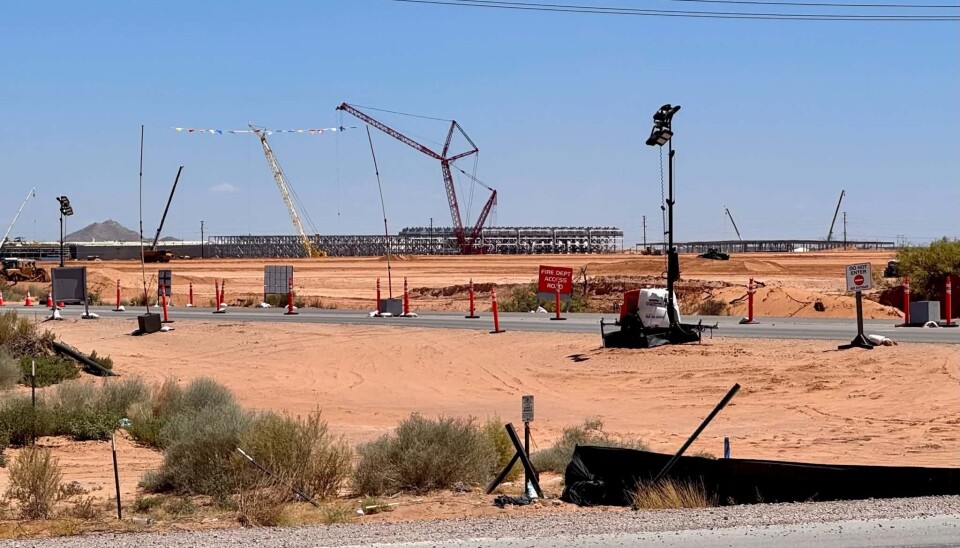
The data center began construction last September on over 1,400 acres of on vacant land three miles north of the Santa Teresa Port of Entry. The complex of data centers and office facilities is intended to house AI training technology for Oracle Corp. and OpenAI.
As of June 30, spending $144.5 million on preliminary work for the microgrid, bringing it to 10% completion.
“The public was being railroaded through a process designed to move at extraordinary speed while opponents were denied the tools necessary to test the Applicant’s claims,� Nanasi said in her written statement. “That sequence of events raises grave questions about political pressure and whether this process was being driven toward a predetermined result instead of a search for the truth.�
Algernon ¶Ù’A³¾³¾²¹²õ²õ²¹ is the Journal’s southern New Mexico correspondent. He can be reached at adammassa@abqjournal.com.


